The accessibility of scientific knowledge constitutes a particularly fruitful category of inquiry for the early modern period. Between the fifteenth and seventeenth centuries, the sciences took shape through a plurality of institutional, editorial, rhetorical, and disciplinary channels that shaped their production and circulation. What does it mean to access the sciences, and how was this concept understood in the period under consideration? Is there a single point of entry, or multiple ones? Who or what regulates access? Where and how are boundaries established? Who and what is included? Who and what is excluded?
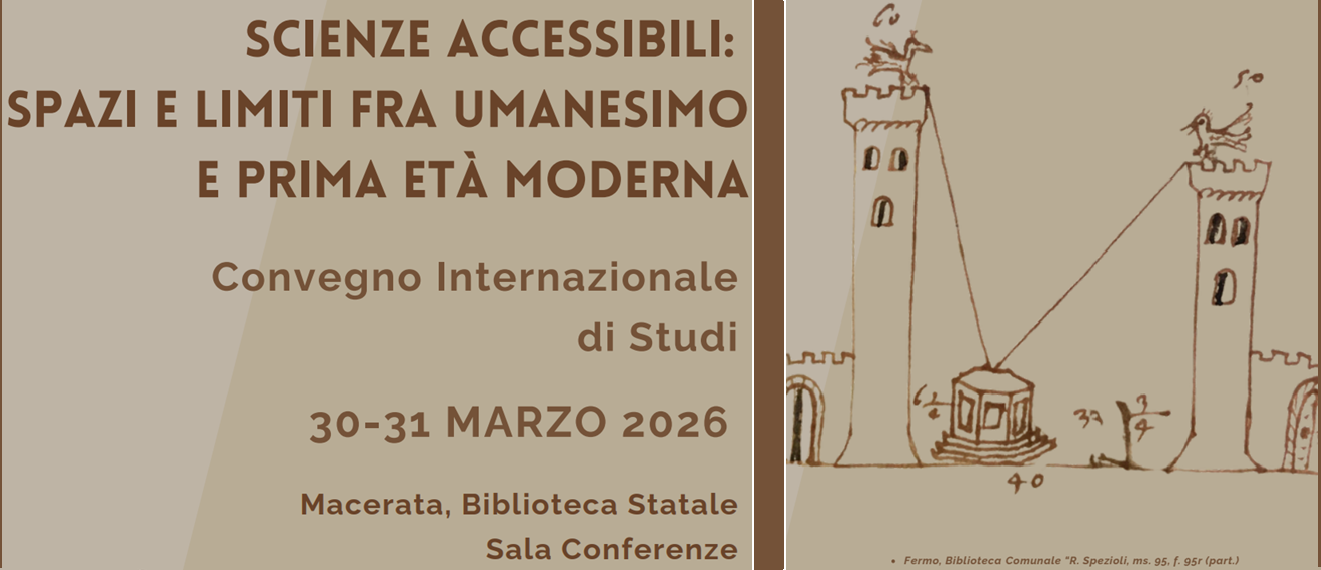
These questions, far from merely rhetorical, form the epistemological core of the International Conference Accessible Sciences: Spaces and Limits between Humanism and the Early Modern Period, to be held on 30 and 31 March at the Conference Room of the Biblioteca Statale di Macerata.
The initiative arises from the synergy and intersection of two major research projects conducted at the Department of Humanities of the University of Macerata: the PRIN 2022 project From Heavens to Earth. The Scientific-Didactic Literature of the 15th and 16th Centuries (coordinated for the UniMC unit by Prof. Silvia Fiaschi), and the MSC project Jophil. Re-orienting the Foundations of New Science: John Philoponus and the Modern Theories of Space and Void (1520–1604), carried out by Dr Tommaso De Robertis (supervisor Prof. Guido Giglioni).
Two days of proceedings, organised into three thematic sessions («Genres, Spaces and Solutions», «Medicine», and «Science and Religion»), offer the opportunity to examine the ways in which scientific knowledge and practices were elaborated, transmitted, and made accessible between the fifteenth and seventeenth centuries. The inquiry unfolds across multiple disciplinary perspectives – literary, philological, philosophical, art-historical – and a broad range of fields spanning medicine, rhetoric, astrology, painting, poetry, the history of thought and religion, preaching, publishing and manuscript production.
Spearkers: Alberto Maria Amoruso, Corinna Bottiglieri, Stefano Brogi, Cécile Caby, Francesca Coltrinari, Claudia Corfiati, Tommaso De Robertis, Silvia Fiaschi, Guido Giglioni, Leonardo Graciotti, Michele Merlicco, Renato Ricco, Michele Rinaldi, Sofia Russo.
In keeping with the theme of the Conference and the city in which it takes place, the programme includes
a guided visit to the Planetary Clock of the Civic Tower of Macerata, a remarkable mechanical masterpiece for
the measurement of time completed in 1571, which reminds us that time has always represented the starting
point of every form of knowledge.
The conference is accredited for the Degree Programmes of the Department of Humanities and is open to researchers, doctoral students, and graduate students with interests in the history of science, humanist philology, and natural philosophy of the early modern period. The event may also be followed remotely via Microsoft Teams.
Browse the programme 👇